Supply and UDI systems
Publicly reviewed supply and UDI products describe inventory, usage, recall, explant, and chain-of-custody workflows.
Observed public positioningBounded workflow loading
The interface is loading. No clinical action is performed by this state.
Orthopaedic implant lifecycle intelligence
In this fictional demonstration, Synorthopic links cited implant evidence, flags unresolved lifecycle statements, and prepares a consolidated human review. The public demonstration makes no removal decision and sends no EHR task, message, claim, order, or patient contact.
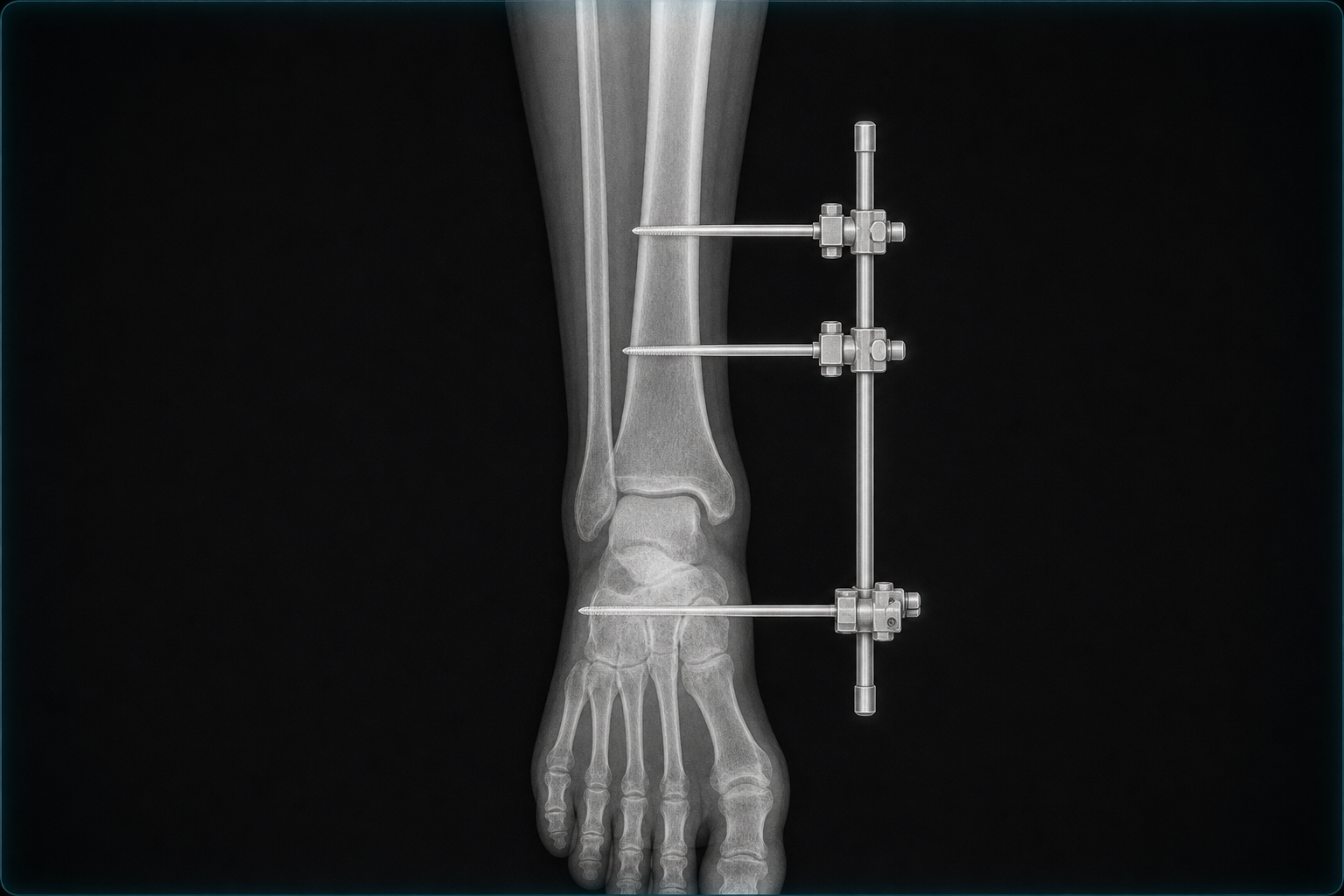
Selected exceptionAdult ankle · external frame
Verify now“Plan return to OR for frame removal after consolidation, approximately 10–12 weeks.”
What Synorthopic does not claimHardware presence and clinical need for removal remain unconfirmed in this fictional example.
Illustrative interface · fictional data · decisions remain with authorized humans
hardware-removal cases involving 2,176 children in one tertiary-center retrospective series from 2012 through 2023
overall complication rate reported in that Level IV retrospective series; the study did not evaluate Synorthopic
FDA describes standardized UDI documentation as supporting more precise device identification and longitudinal safety evidence; this does not establish local data completeness.
Imaging in context
Imaging may help a reviewer orient to an episode, but this product does not infer hardware presence, removal need, urgency, or lifecycle closure from pixels.
Original study stays authoritativePACS and the signed radiology report remain the clinical sources; the public illustration has no diagnostic authority.
No image-only dispositionRemoval, retention, and urgency are not inferred from the synthetic image.
Human verification requiredA qualified human must confirm device identity and any intended next step from authorized clinical sources.
The category gap
The reviewed market includes supply/UDI, registry, engagement, and revenue-cycle products; Synorthopic's proposed distinction still requires competitor demonstrations and customer validation.
Publicly reviewed supply and UDI products describe inventory, usage, recall, explant, and chain-of-custody workflows.
Observed public positioningPublicly reviewed registry and care-pathway products describe outcomes collection, follow-up, and patient-engagement workflows.
Observed public positioningPublicly reviewed revenue-cycle products describe coding, eligibility, authorization, claim, and denial workflows.
Observed public positioningSynorthopic proposes a separate focus on longitudinal, source-cited lifecycle reconciliation and human-owned closure.
Proposed Synorthopic scopeA narrow job, done end to end
Tested synthetic workflows keep placement, follow-up, removal, and conflicting evidence separated until identity is supported.
Tested rules separate supported facts, unresolved lifecycle states, conflicts, and abstentions on fictional records.
The implemented workflow prepares a cited exception and role target but sends no external task in this public release.
After final human review, the software can prepare documentation, coding, authorization, or coordination packets without submitting them.
Useful to surgeons only if it disappears into the workflow
Proposed workflow: staff review routine evidence packets and involve the surgeon only when a clinically meaningful ambiguity remains.
Source-first inputDesign target: use approved chart and device sources before asking staff to re-enter implant data.
Transparent reviewReview output must show the source, date, conflict, and uncertainty behind each candidate fact.
Staff-first routingProposed routing sends routine administrative review to configured staff queues and escalates unresolved clinical ambiguity.
Clinical authorityRemoval and retention judgment remains with the authorized treating clinician.
Does this staged spacer still have an active exchange plan?
“Return for definitive reconstruction once infection markers normalize.”Illustrative only · no decision is transmitted
The market wedge
Proposed wedge: source-cited reconciliation and human-owned closure of removal-sensitive implant episodes across fragmented records.
Proposed wedge: source-cited reconciliation and human-owned closure of removal-sensitive implant episodes across fragmented records.
Possible expansion: prepare human-approved scheduling, outreach, and documentation tasks only after lifecycle confirmation and channel authorization.
Possible expansion: prepare evidence-linked coding and prior-authorization packets for qualified human review without autonomous billing or submission.
Pilot design studio
A credible pilot requires a bounded cohort, an independent reference review, predeclared metrics, and no outcome claim before analysis.
Do not expand beyond the approved study envelope until independent review establishes acceptable source correspondence, error severity, reviewer burden, and safe abstention.
Integration boundaries
Implemented contracts: SMART/FHIR authorization, selected FHIR R4 reads, and bounded Bulk Data processing; no live customer endpoint is configured.
Contract tests do not establish customer registration, resource availability, mappings, credentials, canaries, uptime, or production approval.Implemented boundary: DI-only AccessGUDID lookup and customer-catalog contracts; registry data cannot prove implantation or lifecycle state.
The lookup is not customer-authorized egress, point-of-use capture, exact patient-device linkage, or a complete local catalog.Implemented packet contracts can organize eligibility, coding, and prior-authorization evidence; no payer connection, final code, medical-necessity decision, or submission is live.
No payer policy, terminology license, clearinghouse, portal, denial, payment, or comparative revenue result is verified.Future customer actions may use approved EHR tasks, scheduling, messaging, repositories, or calendars; this build has no production write connector.
Each external action requires a separately approved adapter, human gate, permissions, audit, failure recovery, canary, and customer authorization.Trust is a product surface
Pilot-stage product · synthetic demonstration. Every higher state remains gated by its own evidence.
Inspect the executable readiness gatesPublic demo data boundaryPublic routes are restricted to fictional or explicitly de-identified data; identified PHI is not authorized for this deployment.
Human-in-control boundaryThis release blocks autonomous clinical orders, removal or retention disposition, final code confirmation, payer submission, and patient contact.
Evidence provenanceTested review objects retain source references, dates, and exact quoted evidence in fictional workflows.
PHI-capable deploymentAny PHI-capable customer deployment requires a BAA determination, risk analysis, approved infrastructure, workforce controls, incident response, and signed operating authorization.
Independent security attestationNo SOC 2 report or HITRUST certification is available for this public deployment.
Evidence before outcome claims
hardware-removal cases involving 2,176 children in one tertiary-center retrospective series from 2012 through 2023
A retrospective single-center case series does not establish prevalence, causality, a universal removal rule, or any Synorthopic effect.Open PubMed ↗Clinical boundaryA literature review found no clear general recommendation for routine pediatric implant removal; benefits and risks remain case-specific clinical judgments.
A narrative review cannot determine the appropriate plan for an individual patient, implant family, or current local protocol.Open PubMed ↗Policy direction · FDAFDA describes standardized UDI documentation as supporting more precise device identification and longitudinal safety evidence; this does not establish local data completeness.
FDA's description of UDI-system benefits does not prove hospital adoption, local capture quality, patient-device linkage, or Synorthopic performance.Open FDA ↗Access infrastructure · CMSCMS-0057-F requires specified impacted payers to implement prior-authorization APIs on varying compliance dates generally beginning January 1, 2027; it does not connect this deployment.
The rule has defined payer scope, exclusions, standards, and varying dates; real workflows still require payer implementation, registration, mapping, and end-to-end testing.Open CMS ↗Current claim ledgerProduct-market fitNot establishedClinical outcome improvementNot establishedTime savingsNot measured in a customer workflowMarket differentiationHypothesis only
72 repository-reviewed statements · 4 boundary-only outcomes · 0 overdue reviewsA wedge worth testing, not pretending is proven
Do not expand beyond the approved study envelope until independent review establishes acceptable source correspondence, error severity, reviewer burden, and safe abstention.